…
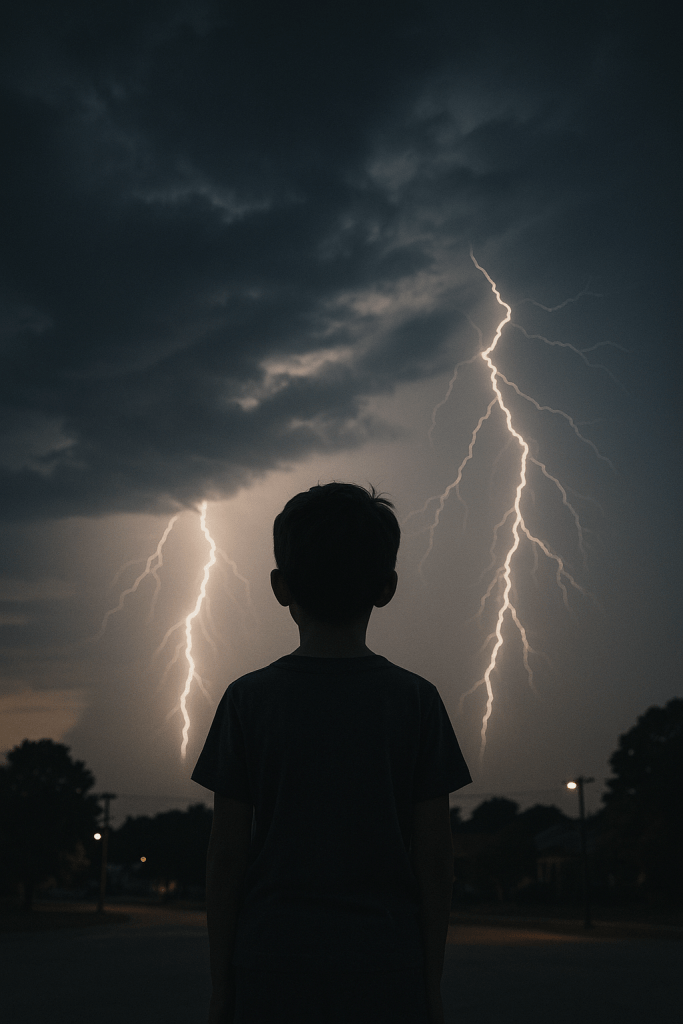
As children, we believe the world is watching us — that the sky takes our picture when lightning flashes. Somewhere along the way, we stop believing. Or do we? Maybe growing up is not about outgrowing such beliefs, but learning to see their truth differently.
Intro
The question came out of nowhere — When did you really feel grown up?
And instantly, a summer sky flashed before my eyes — the kind that used to rumble with thunder over our red-oxide home in Bangalore. I was ten, believing that the lightning was a camera and that the heavens were taking our picture. Strangely, that moment still feels truer than most grown-up years that followed. Perhaps, I never stopped standing in that light.
When I tried to recall the first time I truly felt “grown up,” memories from long ago began to return — vivid, scattered, alive.
I remembered standing as a five-year-old on the staircase of rented house, watching my toddler friend pedal his tiny bicycle across the lane.
I remembered the spherical vanilla ice cream my father bought me on my 4th birthday — a novelty then, when there was no concept of cake.
And I remembered that evening of thunder when my sisters, our neighbours, and I stood outside posing like models as lightning streaked across the sky. Cameras were rare in the 1970s, but to us, that flash was a camera. We believed the heavens were taking our picture.
Even after we moved to Hyderabad, I kept waiting for that photograph — a picture taken by the sky. Somewhere deep inside, I still am.
The Dialogue Within
Child:
When did you really grow up?
Adult:
You know, I thought I had, many times. But each time I felt grown-up, life found a way to remind me I hadn’t.
Child:
So, you never did?
Adult:
Maybe not completely. When I was your age, I thought growing up meant knowing more. But now I see it’s about seeing differently.
Child:
Seeing what?
Adult:
That life keeps changing its form. Remember that thunderstorm evening when we thought lightning was a camera? That belief — that wonder — wasn’t wrong. It was innocent truth. You saw the divine in play. I’ve spent years learning to see like that again.
Child:
But we never got the photograph!
Adult:
Oh, we did. It wasn’t meant for paper. It was meant to stay inside. Every time I recall that evening, that photograph reveals itself again — alive in memory.
Child:
Do you still think of that birthday ice cream?
Adult:
Yes. And the jackfruit kheer, the smell of rain, the rocking of the train after we reached Hyderabad… each of these small things is a world by itself. Childhood isn’t gone; it just moved deeper within, waiting to be remembered with gentleness instead of nostalgia.
Child:
Then why do people want to grow up so quickly?
Adult:
Because we mistake becoming for arriving. We think life has a destination called “adulthood.” But growing up isn’t a finish line — it’s a rhythm. It keeps happening every day.
Child:
That sounds confusing.
Adult:
It is — and it isn’t. Think of it this way: every morning, even as a schoolboy, I used to wake up feeling a little older than the day before — determined to outgrow yesterday’s ignorance. That feeling hasn’t gone away. Even now, I wake up hoping to be a slightly better person. But each time I think I’ve “grown,” I find another layer waiting to unfold.
Child:
So you keep growing and un-growing?
Adult:
Exactly. That’s the paradox. Growth often feels like addition — more knowledge, more wisdom, more control. But the deeper truth is subtraction — letting go of certainties, peeling away illusions. We become more by holding less.
Child:
So what happens at the end of all this growing?
Adult:
Perhaps that’s what they call moksha — the moment when there’s nothing left to outgrow because you realize you were never small to begin with. Every phase of life is a partial glimpse of that completeness. Growing up, in the truest sense, is remembering that wholeness.
Child:
So I’m not supposed to disappear?
Adult:
No, you’re meant to stay — as a pulse, a fragrance, a reminder of what’s real. You are the child who believed the sky could take a photograph. I’m the adult who finally understands why you were right.
Living the Paradox
Perhaps this is what it means to live the paradox — to keep evolving outward into the world while returning inward toward the Self.
We often think of “growing up” as a one-way ascent: from innocence to knowledge, from dependence to independence, from childhood to maturity.
But in truth, each ascent carries its own descent — from certainty back into wonder, from noise back into silence, from knowing back into being.
The child within us doesn’t vanish; it ripens. Each joy, each loss, each rediscovered taste or scent is a reminder that growth isn’t linear — it spirals.
We keep circling back to the same places, only with deeper eyes.
So perhaps the question isn’t When did you grow up? but How do you keep growing without losing what’s tender, trusting, and true?
Somewhere between the child who waited for the lightning’s photograph and the adult who still looks for that light in every memory lies the journey of a lifetime — a growing that never ends, and a completeness that never left.
Closing Reflection
Every moment of life, however ordinary, is a small initiation into awareness.
The paradox of growing up is that we chase an arrival that doesn’t exist — until one day we realize that growing is not about reaching the end, but about returning home to where we began, awake.
Perhaps, after all, the only real photograph ever taken was that —
a flash of light,
a moment of awareness,
printed forever in the soul’s own sky.
 Site Title